
I Found Jesus. He Was Behind the Sofa the Whole Time.
For most of her life, Debbie blamed her mother for everything that went wrong: her father leaving, being sexually assaulted at age six by her brother’s friends and later by one of her mother’s boyfriends. She had a right to be angry, but not, as she would later realize, to hold on to unforgiveness. It would take disposing of the contents of a dusty old box she had kept hidden for decades and a parting gift from her mother for her to see through a glass perhaps, a little less darkly.
When Debbie was high, which was often, she would look up and see Jesus staring down at her from a frame high above her sofa. It was unsettling to say the least. Usually, she ignored the Most High God’s penetrating gaze—until one day He upped the ante and spoke to her—issuing her an imperative. “Hey, you have a lot of life left. So, pull your head out of your…”
Whether Jesus would use that specific turn of phrase, let alone speak from a picture frame, is debatable. But what wasn’t debatable was the effect those words—real or imagined—had on Debbie. “I immediately got off my sofa and poured the rest of the alcohol down the sink,” says Debbie. “Then I came to the Mission, got the application, did my interviews, and here I am.”

Debbie’s gone through the Recovery Program, twice—the first time in 2017, and then again in 2024. Before then, she’d went through the revolving door of rehab more times than she could count. “Why couldn’t I get it?” laments Debbie. “In and out, in and out of rehab and jail. Why couldn’t I have got it the first 2, 3, 4 or 5 times”?
When her mother died in April of 2024, Debbie relapsed yet again. “I wasn’t a very good daughter, and I carried around a lot of shame and guilt over that,” says Debbie. “So, I did what I usually did to numb the pain…I drank.”
Men Behaving Badly…and Mom, Too
It could be argued that Debbie’s guilt was out of proportion to the level of abuse her mother inflicted upon her—not the least of which was her mother’s refusal to reveal the identity of Debbie’s biological father. All three siblings had different fathers, none of whom were involved in their lives. Instead, there was only their alcoholic mother and a revolving door of men who never stayed around long enough to qualify as father figures.
“Back in the day when there were pay phones, I would get rolls and rolls of quarters and go through the phone book—calling every person I thought might be my father,” says Debbie. “But I always got shot down.”
One day, when Debbie was six, her mother left her in the care of her older brother. Free from parental restraints, he invited his party-loving friends over and soon the alcohol flowed freely. But it was no party for Debbie. Two of her brother’s friends molested her—a secret she kept for a very long time.
Two years later, one of her mother’s boyfriends molested her again. This time, Debbie spoke up. At first, her mother wouldn’t believe her. But eventually she did, and the boyfriend was kicked to the country curb.

Half and Half
Not surprisingly, by her early teens, Debbie began to act out through a series of destructive relationships. “When stuff like that happens to you as a child, you just seek it out,” says Debbie. To cope, she turned to her emotional numbing agent of choice: alcohol. She would spend the next five decades trying to escape its clutches.
The condemnation over her repeated failures to get sober was nothing compared to the guilt she felt after her mother’s death. “Guilt, guilt, guilt…it was constant guilt over not being the daughter I should have been,” laments Debbie. “But I take comfort in knowing that in the end, my mother had truly surrendered her life to the Lord. Before then, I’d describe her as a ‘half and half’ believer…half in, and half out.”
“I’m Sorry. Please Write Back.”
At almost 60, Debbie knows her days of running amok “like a rolling stone with no direction home” are over. Still, she struggles with abandonment.
“All my life, I felt rejection—from both parents,” says Debbie. “And yet in my Bible study, they said God chose my parents. So, I asked Him, ‘Lord, I didn’t do nothing wrong. So, why didn’t my dad want to see me?'”
Debbie asks a similar question about her oldest son, though she never questioned that she played a significant role in his continued refusal to have contact with her. Desperate to make amends, she sent her incarcerated son a letter. “I’m so very sorry for all my past mistakes,” Debbie wrote. “With all my heart, I wish you could have the childhood you never had—to play and be happy. I love you so much.”
She hoped for a reply but until very recently had never received one.

“Please tell her I’m okay.”
In a “too coincidental not to be God” set of circumstances, a man named Gus from a local church had written a note of encouragement to a random inmate housed in the next county—only to receive a reply months later in which the inmate wrote, “Thank you kindly for taking the time to write me. Do you by chance know the faith-based recovery program my mom is in? Because I’ve been trying to find her, but I don’t know where she is. If my mom is there, please tell her I’m okay and that I love and miss her from the deepest part of my soul.”
That letter was from Debbie’s son, Justin—the prodigal son of the prodigal daughter. He ended the letter with something Debbie had longed to hear: “Prison sucks, but me and God our settling our differences. We talk every day. Thankfully, we’re now on the same page. And it feels good to be walking on the right path—getting closer to Him after spending years wasting my life.”
Within days, Debbie held that letter in her hands—a miraculous moment that marked yet another chapter in her redemption story.

The Baptism and the Box
On September 1, 2024, Debbie was baptized at a local church. Both of her grandsons were there, and both heeded the altar call.
“My two grandsons looked at me and before you know it, I had grabbed both of their hands and we all went up—myself to be baptized and the two boys to ask Jesus into their heart,” recalls Debbie. “And suddenly I felt like an angel had opened its wings and closed them all around us. The presence of God was so strong. And my grandsons had this beautiful grin on their faces. And of course I started bawling.”
Today, Debbie is nine months sober and growing by leaps and bounds. She is walking through those parts of her painful past that have kept her stuck in a cycle of anger and unforgiveness. Some of that pain she had kept locked up for decades—encased in a dust-covered box underneath her bed. When asked what that box contained, she answers, “The rapist…to be specific, a piece of clothing I was wearing when I was raped.”
Debbie would never open the box because she knew she’d have to forgive the boys who had raped her. And that she couldn’t do. “I had asked my therapist, ‘Why should I forgive somebody that hurt me and doesn’t deserve forgiveness?'” says Debbie.
Recently, Debbie summoned the courage to finally open the box, throwing out the piece of clothing connected to the most traumatic day of her life. “I forgave those boys,” said Debbie. “It was the hardest thing I ever did but I just couldn’t carry that burden one more day.”

The Robe
Before her mother died, she had given her daughter a gift of a purple bathrobe. It hangs on a hook in her room—the only thing left to remind her of that once troubled relationship. Purple, it was pointed out to Debbie, is the color of royalty—a color represented countless times in the Bible. It’s doubtful her mother knew then the significance of that gift. But she knows now. “For now we see through a glass, darkly; but then face to face: now I know in part; but then shall I know fully even as also I am known” (I Cor. 13:12.)
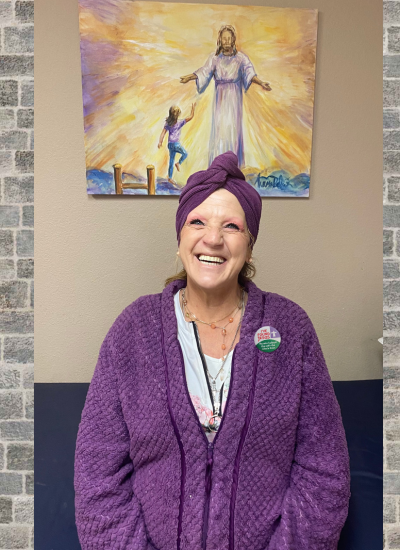
Each evening, when Debbie dons that purple robe while standing underneath her favorite picture of a child reaching towards Jesus, she’s reminded of who she really is: the royal daughter of Ha’av Shadvak Besviva, or The God Who Sticks Around. She’s no longer rejected, cast off or abandoned. From God’s perspective, she never was.
As for her mother, if she could send a letter of amends from the Other Side, it might sound a lot like the one Debbie sent her son:
“I wish I could take it all back so you could have had a better life,” her mother would say. “I can only say while on earth ‘I saw through a glass darkly and knew only in part.’ But you, my precious daughter, have Jesus in your heart and He’s the Perfect Parent…He’s everything you need. So, go and be a child again—happy and free. I love you from the deepest part of my soul.”

###